

The hospitality landscape has hit a “Breaking Point of Genericism,” where consumers now favor “Premium Simplification”, where consumers are choosing to go out less frequently but with much higher intentionality and aiming for unique offerings.
Experienced chefs in Indianapolis are perfectly aligning with a revolutionary lifestyle, replacing the friction of crowded Mass Ave restaurants with chef-led, immersive boutique experiences. You can receive such catering or personal chef services, whether you are in Indy’s premier Airbnb or hosting events like the Indy 500.
1. The “Anti-Catering” Model ─ When the Chef Stops Hiding
Most catering is anonymous by design. Food is produced elsewhere, decisions are made weeks ago, and the person responsible for the menu is nowhere near the moment it matters. That model optimizes for volume, not excellence.
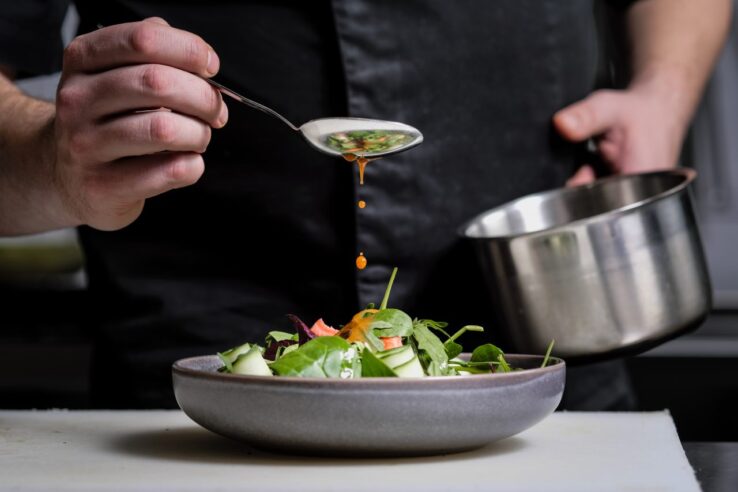
The chef-led immersive approach rejects that entirely. Here, with Catering Service Indianapolis professionals, chefs show up, cook, and adjust positively; that’s owning the outcome. It’s no longer about “getting food delivered” ─ it’s about The Chef as the Main Event; the chef doesn’t disappear behind staffing layers.
Here is how the core differentiators of the chef-led experience function as a unified strategy
- Direct dining solutions: No “checking with the kitchen.” The kitchen is right there, and the person in charge is holding the knife.
- Adaptive culinary artistry: What’s planned can change, because if a guest mentions a craving or a last-minute allergy, the chef pivots in real-time.
- True ownership of culinary yield: Accountability isn’t a policy; it’s the person. You get the chef’s name, their signature on every plate, and their personal guarantee on the night.
For guests, this doesn’t feel like service; it feels like guidance. For partners and investors, it signals something rare: a system built on authorship, not delegation. Fewer parts. Fewer excuses. Better results.
Source: phoenixmag.com
2. Turning Short-Term Rentals into Experience Engines, Not Just Real Estate
High-end rentals aren’t losing bookings because of design, they’re losing differentiation. Travelers aren’t asking, “Is it nice?” They’re asking, “Will this feel complete?” Leveraging the expertise of chefs to enhance culinary residency is fundamentally different from a restaurant visit or a catering delivery because it removes the “public” barrier. It transforms a temporary living space into a private theater of flavor.
A chef-led dining experience turns the kitchen from background scenery into a strategic asset.
- Guests stay in instead of fighting traffic or waiting on reservations
- Hosts elevate their offering without managing another vendor
- The home becomes the destination, not just where people sleep
In places where taste matters, historic neighborhoods, downtown lofts, thoughtfully restored homes, this isn’t indulgent. It’s aligned. It’s how a stay stops feeling transactional and starts feeling intentional. Quiet luxury has a very clear ROI.
3. Menu Design That Starts with Listening, Not Options
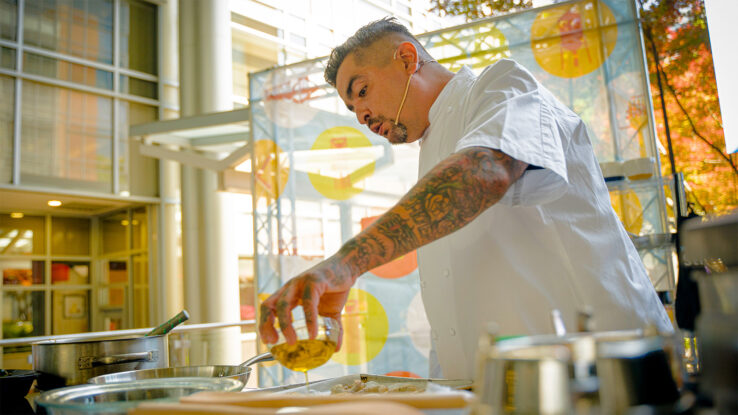
Most catering asks people to choose. This model asks them to talk. Instead of preset packages, menus are shaped through conversation, why people are gathering, what matters to them, what they want to avoid, what they’re celebrating or closing.
Instead of locking you into a preset menu, these food experts arrive with an open mind and comprehensive expertise. Their goal? To curate your specific preferences through the lens of seasonal availability, unbound by the static limitations, overhead, and ‘fixed-batch’ constraints of a traditional restaurant.
That opens the door to:
- Menus that reflect seasons, local moments, and cultural context
- Serious dietary precision without awkward compromises
- Food that matches the reason for the meal, not just the headcount
This isn’t customization for novelty’s sake. It’s relevance. Large operations can’t do this because they’re built to standardize. A boutique chef-led service turns attention into its sharpest tool—and listening into its edge.
Source: unpretentiouspalate.com
4. Transfer of Culinary Mastery ─ Education as Experience, Not a Lecture
Your personal chef will not just provide a meal; they will offer a tactical apprenticeship in the techniques that elevate simple pantry staples into gourmet outcomes. For example, they will explain why you chose a specific cut of meat or why a certain aromatic is used. You don’t want to be taught. You want to understand.
Such an experience transforms you from a “consumer” into a “connoisseur.”
There’s a difference.
In modern luxury dining, guests want access, on their terms. They want to know why something tastes the way it does, where it came from, and what makes it worth remembering.
That might look like:
- Light, optional cooking moments woven into the night
- Stories about ingredients that connect place and technique
- Formats that turn dinners into shared discoveries, not performances
People forget menus. They don’t forget insight. From a business lens, this is where a single evening becomes a story guests repeat, and repetition is what sustains premium positioning.
5. Hyper-Local Dominance Instead of Being Everywhere
Here, it’s not about a chef who understands the vibe of a Mass Ave loft better than anyone else. Its about a chef’s relevance that comes from deep connection to the specific needs of an Airbnb host, the local culture, and the local farmers.
This model doesn’t try to serve the whole city. It focuses on the rooms that matter, the neighborhoods where taste concentrates and influence circulates.
Hyper-local aligned services ensures:
- Elite sourcing: Fresh menus that evolve with neighborhood identity
- Atmospheric pairing: Menus curated to match the specific “soul” and energy of the district.
- Vetted excellence: Trusted local authority proven by community reputation rather than advertising.
By prioritizing a personal-local chef over mass services of a restaurant, you receive a “curated residency” rather than a standard service. This ensures your event is anchored by ingredients the public can’t access, a “vibe” that feels native to your specific neighborhood, and the peace of mind that comes from a reputation built on local results rather than loud advertising. It transforms a simple meal into an intentional, high-status extension of the city itself.
Source: heriot.co.uk
6. Full Lifecycle Ownership ─ The Discipline of Invisible Luxury
Real luxury leaves no residue. No stress. No mess. No sense of effort. Personal chefs own the entire arc, from sourcing to execution to cleanup. That removes the friction clients usually absorb without realizing it.
- Ingredients arrive with intention, not convenience
- Service happens without colonizing the space
- Kitchens are returned better than they were found
For hosts, this protects the asset. For guests, it preserves the illusion that everything simply worked. For investors, it demonstrates maturity: systems designed to disappear while outcomes remain consistent.
In essence, curated catering services and personal chefs aren’t a trend cycle; they’re a course correction. Away from scale for scale’s sake. Toward culinary specialization, authorship, and trust. In a city like Indianapolis, optimizing the services of curated catering services and a reliable personal chef is the ultimate leverage.
In this model, they aren’t just a vendor; they are the guardian of a delectable and savory outcome.